The Pangolin, 2022 Black ink and graphite on paper
I was drawn to the pangolin because of how defenseless she is — the most trafficked animal in the world, and one of the gentlest. Her only defense is to curl into a ball and wait. I kept thinking about that while I drew her: a creature whose armor is made of the same material as our fingernails, whose body is built entirely for stillness and trust, being hunted to extinction for it.
Drawing her scales was one of the most meditative processes I've experienced — each one overlapping the next, building a surface that looks like armor but feels, in the making, more like prayer. I let flora grow from her back the way I often do, as if the natural world were claiming her, holding her, refusing to let her disappear.
Pangolins are ancient — their lineage stretches back over 80 million years, older than many of the ecosystems they now inhabit. They walk slowly, eat quietly, and harm nothing. In African folklore they are associated with protection and good fortune; in Chinese tradition their scales were believed to hold healing properties, which is tragically the reason they are hunted. The pangolin carries one of the most painful contradictions in the natural world: the qualities that make her remarkable — her gentleness, her patience, her willingness to be still — are the same ones that make her vulnerable.
Premium fine-art giclée print of an original illustration by Nayeli Lavanderos.
Printed on 200 gsm museum-grade matte paper and signed by the artist.
Edition: Open
Available Options:
– Unframed Fine Art Print — Size: 11 × 14 in (28 × 35.5 cm) total paper size, with an A4 artwork area centered within a white border — ideal for framing.
– Framed Black or White — presented in a premium box frame with Perspex glaze and a white mount (passe-partout), ready to hang. Size: 12 × 16 in (30 × 40 cm)
Free worldwide shipping is included with every order. Please allow 5–10 business days for delivery.
Each print is carefully packaged in a sturdy cardboard tube (or boxed within the EU) and wrapped in protective tissue paper.
The Pangolin, 2022 Black ink and graphite on paper
I was drawn to the pangolin because of how defenseless she is — the most trafficked animal in the world, and one of the gentlest. Her only defense is to curl into a ball and wait. I kept thinking about that while I drew her: a creature whose armor is made of the same material as our fingernails, whose body is built entirely for stillness and trust, being hunted to extinction for it.
Drawing her scales was one of the most meditative processes I've experienced — each one overlapping the next, building a surface that looks like armor but feels, in the making, more like prayer. I let flora grow from her back the way I often do, as if the natural world were claiming her, holding her, refusing to let her disappear.
Pangolins are ancient — their lineage stretches back over 80 million years, older than many of the ecosystems they now inhabit. They walk slowly, eat quietly, and harm nothing. In African folklore they are associated with protection and good fortune; in Chinese tradition their scales were believed to hold healing properties, which is tragically the reason they are hunted. The pangolin carries one of the most painful contradictions in the natural world: the qualities that make her remarkable — her gentleness, her patience, her willingness to be still — are the same ones that make her vulnerable.
Premium fine-art giclée print of an original illustration by Nayeli Lavanderos.
Printed on 200 gsm museum-grade matte paper and signed by the artist.
Edition: Open
Available Options:
– Unframed Fine Art Print — Size: 11 × 14 in (28 × 35.5 cm) total paper size, with an A4 artwork area centered within a white border — ideal for framing.
– Framed Black or White — presented in a premium box frame with Perspex glaze and a white mount (passe-partout), ready to hang. Size: 12 × 16 in (30 × 40 cm)
Free worldwide shipping is included with every order. Please allow 5–10 business days for delivery.
Each print is carefully packaged in a sturdy cardboard tube (or boxed within the EU) and wrapped in protective tissue paper.

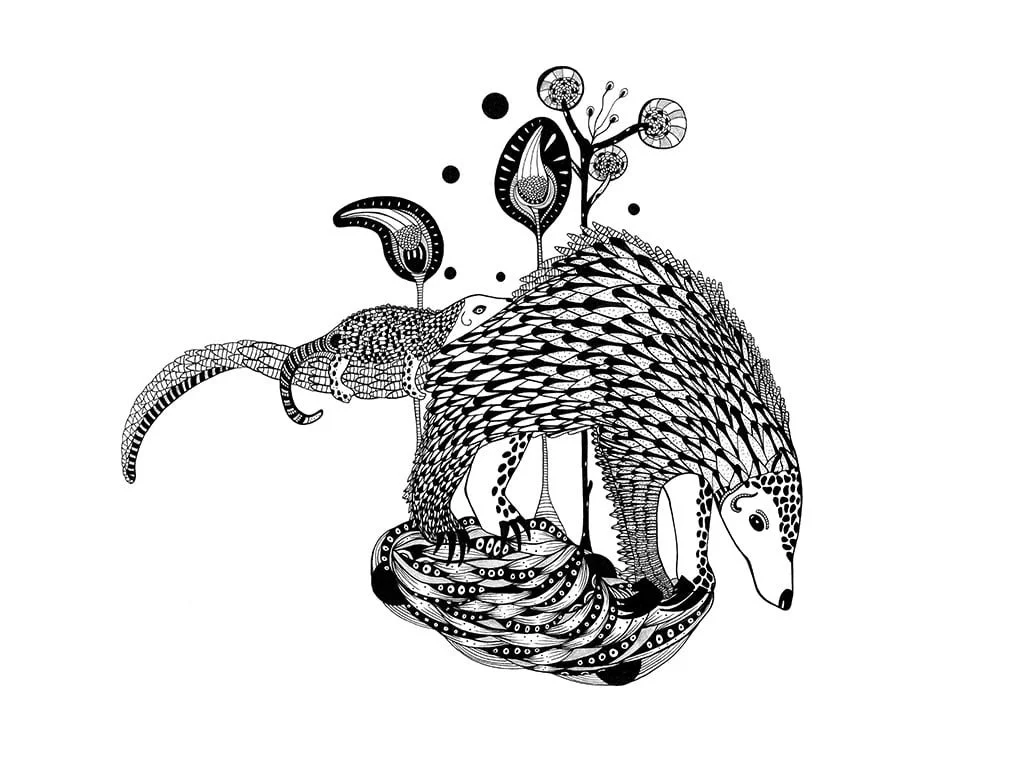 Image 1 of 3
 Image 2 of 3
 Image 3 of 3
